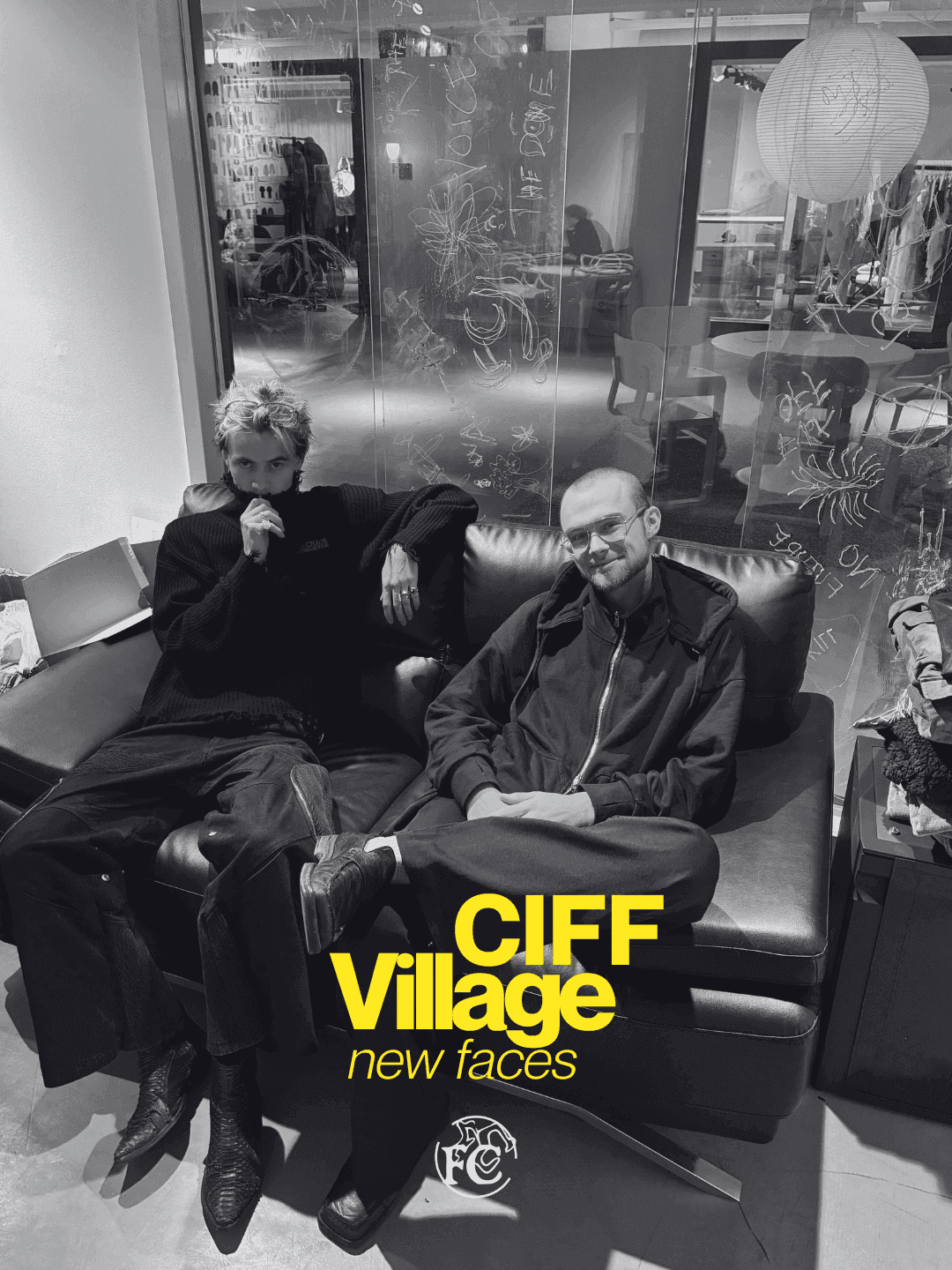
This year, we welcomed a lot of new brands in CIFF Village – each bringing new designs and faces to the showroom community spanning 20,000 square meters on the first and second floor of Bella Center Copenhagen.
In this interview we're highlighting Fine Chaos, the Copenhagen brand known for its androgynous, expressive designs. Our collaboration with founders Marc Møller Skov and Ludvig Isaksen dates back to their very first season, evolving as the brand has grown.
At our latest edition in August, they expanded from a 50 sqm setup to a 550 sqm experience and closed CIFF with their runway show. Now they’ve established a 100 sqm office and atelier in CIFF Village, where their team is already working on what’s next for our January edition.
Can you tell us a bit about your role at FINE CHAOS and the story behind how the brand came to be?
ANSWERED BY LUDVIG ISAKSEN, COMMERCIAL DIRECTOR
I’m the Co-Founder and Commercial Director of FINE CHAOS. Marc originally founded the brand, and I joined him when I had just turned 18. We actually connected through LinkedIn, which is still surreal to think about, but it was the platform we met through, with Marc remembering it as “this one sewing kid who texted me on fucking LinkedIn??”.
Marc came from a London College of Fashion background and was building a world that felt uncompromisingly true to himself. I joined first to learn from him – helping with sewing, assisting on his bachelor collection – and over time as he committed to FINE CHAOS fully, I was offered a work-to-ownership agreement. That agreement kept expanding, and I’ve now invested three times into the company alongside our partners, being a solely bootstrapped company.
From the very beginning, the ambition wasn’t to build a product line – it was to build something that carries meaning, built by the people involved in it – something more than just product. The brand has evolved the same way we’ve evolved as individuals, but that core intention has stayed the same.
Your design ideology is built around longevity, storytelling, and confident expression. How do these three pillars influence your everyday creative decisions?
ANSWERED BY MARC C. MØLLERSKOV, CEO & CREATIVE DIRECTOR
We work with storytelling in every aspect of the brand, no matter if it is the design or sales department. It is within everyone in the team – we want to tell stories and make that the main part of why people should buy and wear FINE CHAOS, which then hopefully translates into longevity as people become connected to the brand. Therefore, every piece of product that we make must have a piece of our story or DNA, else we shouldn’t make it. No compromise. And that should hopefully then come off as a confident presence, which we aim to give every member of the community purchasing our products. There’s nothing better than hearing people telling us that our clothes / products give them confidence to be truly themselves – in expression and their presence. That is the biggest compliment we can get.
What role does “imperfection” play in your vision of beauty and value?
ANSWERED BY MARC C. MØLLERSKOV, CEO & CREATIVE DIRECTOR
Imperfection is needed for every good idea to become the best. If the idea is perfect, there is most likely no nerve in it. We treat imperfection not as a flaw, but as a design language. This shows up through our disrupted silhouettes, raw finishes, over-visible construction, asymmetry, and materials that change over time – like our signature Cargo Trousers, where the holes distress more and more over time and, through a FINE CHAOS lens, become more beautiful.
Another example is found in the brainstorm phase of our collections, where we chase something that provokes us from the everyday world. By starting this way, the anger fuels a creative mindset that aims to enlighten what is wrong – not to solve it. In that way, we work with imperfection throughout the whole collection and try to depict it in multiple ways. We try to portray life as what it is: an imperfect journey of solving problems in a race toward chasing the perfect, which doesn’t exist. Funny, isn’t it?
FINE CHAOS is known not only as a fashion brand but also as a cultural movement. When did you realize that community would be at the heart of the brand?
ANSWERED BY LUDVIG ISAKSEN, COMMERCIAL DIRECTOR
From the very beginning, the core idea has always been about people. We want to create something more than just products – but you can only do that if the people around the brand feel connected to something deeper. A product only gains meaning because someone defines it, and that “someone” has always mattered to us.
We realized just how central community was when we started hosting events. Over the past four years we’ve done events almost every six weeks, and they became our core driver. They allowed us to become who we are. We’re not building something for a community – the community and culture we’re part of has shaped what the brand has become. We often say our garments are only truly finished once they’re on a body. The wearer defines the piece, and that’s central to our philosophy.
What was your highlight or most memorable moment from the show you did at CIFF in August?
ANSWERED BY LUDVIG ISAKSEN, COMMERCIAL DIRECTOR
Throughout the show I was more on the logistics, PR, and marketing sice – but my strongest memory wasn’t during the show itself – it was standing outside the CIFF borders with the whole team that helped build everything. Watching the show from the outside, seeing people’s faces, hearing the loud music and the live DJs, and seeing everyone dance… that was incredible. Another key point was the staircase, where, after having had the entire team & backstage team walk down the runway (back to the point about it being about the people), everyone part of the production gathered and celebrated - visible for all audience to see instead of hiding it backstage.
There was also a really important commercial moment: when a dear friend who used to buy for H. Lorenzo saw the show and said, “Somehow the brand finally makes sense.” It wasn’t just a runway – it was 250 people from outside the industry who had won our raffle, many wearing their FINE CHAOS pieces. Seeing our world expressed through real people made the brand click for others in a new way, and this was the feedback we received through both wholesale, press reviews and more.
You have a showroom here in CIFF Village. How do you use the space – as an office, workspace, showroom, or something else?
ANSWERED BY LUDVIG ISAKSEN, COMMERCIAL DIRECTOR
Our space in CIFF Village functions as our office and atelier. It’s a 100 sqm open-plan setup where everyone works closely together – small enough that sales isn’t separated from design, and everyone naturally interacts across “departments”. We’re still only around eight people, so the space supports a very hands-on, collaborative workflow.
How would you describe the sense of community between you and the other brands in CIFF Village?
ANSWERED BY LUDVIG ISAKSEN, COMMERCIAL DIRECTOR
The CIFF village isn’t only about our own workspace – we have just started to collaborate directly in a partnership with the incredibly talented photographers next to us, engaging in multiple monthly photoshoots. This is what I believe the core ideology of CIFF Village is: to engage an actual community of talented creatives, and urge for collaboration (or just a sense of community) among them.
Are there any upcoming FINE CHAOS projects in collaboration with CIFF that you can share with us?
ANSWERED BY LUDVIG ISAKSEN, COMMERCIAL DIRECTOR
I can’t share much yet – but I can share one thing. CIFF has supported us since the very beginning of our journey into the industry side of Copenhagen Fashion Week. Five years ago, Ask Holmegaard took a chance on us when we barely knew what we were doing.
As our brand and team has developed & evolved season after season, so has our partnership with CIFF. Last season we went from our usual 50 sqm B2B-type trade fair to 550 sqm, constantly surrounded by people from our Community, and closed down CIFF with a runway show.
Now while I’m unable to say too much about the next phase of this partnership yet, we’re not just aiming to scale what we already did, but to become an integral partner with much higher ambitions.
What is one lesson you’ve learned from building a brand from scratch?
ANSWERED BY LUDVIG ISAKSEN, COMMERCIAL DIRECTOR
Everyone on our team would have a different answer, but one common thread is that none of this has been easy. Fashion is a cut-throat industry and one of the hardest markets to operate in – especially right now. But we’re extremely ambitious about what we want to achieve, and our mindset is simple: we may not be “better” than our competitors, but we are willing to outwork them.
For me personally, the biggest lesson is that your first idea for success will almost always fail. If you embrace that, fail fast, relearn, and re-engage, you’re already ahead. Everything I know now has come from a simple loop: have an idea, try it, fuck it up, learn, and try again with new focus. The core lesson here is simply just humbling. You rarely have the right answer at the start. But if you commit a bit of ego-death, go to market, and surround yourself with people and partners more talented than you, you’ll get to the right answer much faster.